Friday, December 28, 2007

Van Morrison


Part Celtic bard, part soulster, and part ecstatically scatting mystical visionary, Van Morrison is a painfully introverted figure who rarely gives interviews and is often at a loss to explain his own lyrics. In the studio, Van Morrison can sing like a soul man getting the spirit; onstage, however, his brilliance can be undercut by whim or temper, and he has upon occasion alienated audiences by rushing through songs and remaining aloof between them. Nonetheless, his influence among rock singer/songwriters is unrivaled by any living artist outside of that other prickly legend, Bob Dylan. Echoes of Morrison’s rugged literateness and his gruff, feverishly emotive vocal style can be heard in latter-day icons ranging from Bruce Springsteen to Elvis Costello, while the Irish artist’s own restless muse has kept him prolific and engaging through the ’90s.

Morrison’s mother sang at social gatherings, and his father collected classic blues and jazz records. He learned guitar, saxophone, and harmonica while in school, and was playing with Belfast blues, jazz, and rock bands by his mid-teens. At 15, he quit school, joined an R&B band called the Monarchs, and toured Europe with them as saxophonist. While in Germany, a film director offered Morrison a role in a movie as a jazz saxophonist. The project was dropped, and Morrison returned to Belfast and opened an R&B club in the Maritime Hotel. He recruited some friends to form Them, which became an immediate local sensation as the club’s house band.

Them recorded two singles in late 1964: “Don’t Start Crying Now” (a local hit) and Big Joe Williams’ “Baby Please Don’t Go” (which made the British Top 10 in early 1965). After the latter’s success, the band moved to London and hooked up with producer Bert Berns. They recorded Berns’ “Here Comes the Night,” which went to #2 in the U.K. and made the Top 30 in the U.S. Them’s next two singles, “Gloria” (by Morrison) and “Mystic Eyes,” were minor U.S. hits; “Gloria” was later covered by the Shadows of Knight (who took the song to #10 in 1966) and Patti Smith. Them’s lineup underwent constant changes, and Berns brought in sessionmen, including Jimmy Page, for their albums. After a mostly unsuccessful U.S. tour in 1966, the group returned to England. Morrison disbanded Them, which soon re-formed with Ken McDowell as vocalist.

Morrison, meanwhile, grew frustrated by music-business manipulations (Them had wrongly been given a rough-kids image by their company), stopped performing, and moved back to Belfast. Meanwhile, Bert Berns (a.k.a. B. Russell) formed Bang Records in New York, and sent Morrison a plane ticket and an invitation to record four singles for his new label. One of them, “Brown Eyed Girl,” reached #10 in the U.S. in 1967. Morrison toured America but was again disgruntled when Berns released the other singles - which Morrison considered demos - as Blowin’ Your Mind. After Berns died of a sudden heart attack in December 1967, Morrison undertook an East Coast tour and wrote material for his next album. Warner Bros. president Joe Smith signed him in early 1968, and Morrison went into a New York studio that summer with numerous jazz musicians. In 48 hours he cut one of rock’s least classifiable, most enduring albums, Astral Weeks, the first manifestation of Morrison’s Irish-romantic mysticism. Though most of its cuts were meandering and impressionistic, with folky guitars over jazzy rhythms topped by Morrison’s soul-styled vocals, critics raved; the album is still considered one of Morrison’s richest, most powerful efforts.

His next album, Moondance (#29, 1970), traded the jazz-and-strings sound of Astral Weeks for a horn-section R&B bounce. The title tune and “Come Running” were chart singles, the latter in 1970 (#39), the former not until late 1977. The fittingly titled “Into the Mystic” became a minor hit for Johnny Rivers, while “Caravan” became an FM radio favorite. It was the first Morrison album to chart in the Top 100, and it eventually went platinum. His Band and the Street Choir (#32, 1970) yielded two uptempo R&B-flavored Top 40 hits in “Domino” (#9, 1970) and “Blue Money” (#23, 1971). By this time, Morrison had moved to Marin County, California, and married a woman who called herself Janet Planet.

Tupelo Honey (#27, 1971) reflected his new domestic contentment. It yielded a hit in “Wild Night” (#28) and went gold, thanks to progressive FM radio, which latched on to the lyrical title tune (featuring Modern Jazz Quartet drummer Connie Kay). St. Dominic’s Preview (#15, 1972) included the minor hit single “Jackie Wilson Said” (#61) and contained two extended journeys into the mystic: “Listen to the Lion” and “Almost Independence Day.” In 1972 Morrison guested on the John Lee Hooker–Charlie Musselwhite album Never Get Out of These Blues Alive.

By the time of Hard Nose the Highway (#27, 1973), Morrison had formed the 11-piece Caledonia Soul Orchestra, which was featured on the live LP It’s Too Late to Stop Now. In 1973, though, Morrison suddenly divorced Janet Planet, disbanded the Caledonia Soul Orchestra, and returned to Belfast for the first time since 1966. There he began writing material for Veedon Fleece (#53, 1974).

Morrison took three years to produce a followup. He reportedly began sessions for an album four different times (one with jazz-funk band the Crusaders), but completed none. By 1976, he was living in California again. Late that year he appeared at the Band’s farewell concert and in Martin Scorsese’s film of the event, The Last Waltz. Finally, in 1977 came A Period of Transition (#43, 1977), which featured short jazz and R&B-oriented tunes and backup by pianist Mac “Dr. John” Rebennack. For Wavelength (#28, 1978), Morrison took on concert promoter Bill Graham as manager (they split in 1981); the album sold fairly well. Still, Morrison’s chronic stage fright continued to plague him. At a 1979 show at New York’s Palladium, he stormed off the stage midset without a word and didn’t return.

The more serene Into the Music (#43, 1979) implied that Morrison had become a born-again Christian, and Common One (#73, 1980) delved more into extended mysticism. Beautiful Vision (#44, 1982) was more varied and concise, and it generated, as usual, sizable critical acclaim and respectable sales. It also included “Cleaning Windows,” which contained references to such Morrison inspirations as Lead Belly, bluesmen Blind Lemon Jefferson, Sonny Terry, Brownie McGhee, and Muddy Waters, as well as Beat author Jack Kerouac and country singer Jimmie Rodgers. Inarticulate Speech of the Heart (#116, 1983) offered “special thanks” to L. Ron Hubbard, founder of the Church of Scientology.

With A Sense of Wonder (#61, 1985), Morrison continued on his spiritual journey and drew further on literary influences, incorporating the work of a favorite poet, William Blake, on the track “Let the Slave.” Meanwhile, Morrison rediscovered his ethnic roots and wanderlust, leaving his California home to travel nomadlike through Dublin, Belfast, and London. On No Guru, No Method, No Teacher (#70, 1986), the singer shared this sense of rebirth, while the album’s title sneered at critics who had tried to pigeonhole his religious beliefs.

Morrison delved deeper into Celtic imagery with Poetic Champions Compose (#90, 1987) and collaborated with Ireland’s best-loved traditional band, the Chieftains, on Irish Heartbeat (#102, 1988). Avalon Sunset (#91, 1989) contained “Whenever God Shines His Light on Me,” a duet with Cliff Richard that became Morrison’s first British Top 20 single since his days with Them, and “Have I Told You Lately That I Love You,” which in 1993 became a #5 U.S. hit for Rod Stewart.

Morrison entered the ’90s with the nostalgia-drenched Enlightenment (#62, 1990), on which he recalled first becoming acquainted with rock & roll and continued to explore the links between spiritual and romantic love. These themes carried over onto the similarly acclaimed double album Hymns to the Silence (#99, 1991), while on Too Long in Exile (#29, 1993), the singer brought things full circle, covering songs by some of his heroes - including Ray Charles and Sonny Boy Williamson - and duetting with John Lee Hooker on Them’s “Gloria,” with enough ardor to dispel any suspicions that age had mellowed him. Hooker, in fact, turned up as a surprise guest at some of Morrison’s concerts in the early ’90s, and Morrison would produce two of Hooker’s albums in the late ’90s. Morrison’s spirited 1993 performances in San Francisco, documented on A Night in San Francisco (recorded December 18), were indicative of his renewed vigor onstage. That same year, Morrison was inducted into the Rock and Roll Hall of Fame. A couple of years later, How Long Has This Been Going On (1996), a live jazz show recorded with Georgie Fame and Friends at Ronnie Scott’s Club in London in 1995 also attested to his renewed energy. Nevertheless, Days Like This (#33, 1995) and The Healing Game (#32, 1997) were railed by critics as predictable, lackluster performances, especially Morrison’s vocals; the former, however, included two duets with his daughter, Shana. Morrison took on an elder-statesman role when the song “Days Like This” was adopted as a peace anthem in Northern Ireland, and he received an Order of the British Empire title in 1996. A prolific artist, he continued his extraordinary output of an album nearly every year, and released The Philosopher’s Stone, a two-disc set of previously unreleased material, in 1998. Back on Top, an album of new material, followed the next year. In 2000 Morrison was inspired by working with other musicians, and he released a concert recording of skiffle tunes performed with Lonnie Donegan, The Skiffle Sessions: Live in Belfast, 1998, and You Win Again, an album of country, rockabilly, and blues covers performed with singer/pianist Linda Gail Lewis, the sister of Jerry Lee Lewis.

Blind Guardian


Commonly the development of any band is judged by the means of their studio albums. But in case of Blind Guardian it's definitely worth it to cast a glance at the dimensions of the live activities in order to appraise the development of the musicians. And these have no peer, not only in Germany!

Already the first live shows of the quartet, which was founded in 1984, showed one thing: Blind Guardian has entertainment qualities, which quickly became a trademark.
Spontaneous acting builds a contrast to all the bands that try hard to deliver their studied ballet. Logically the first big tour took place shortly after the release of the debut album "BATTALIONS OF FEAR" (1988).
From this first tour on, the guys from Krefeld already had between 150 and 300 fans an evening. After the release of the second album "FOLLOW THE BLIND" (1989) an appendix operation put singer (and at that time also bass player) Hansi Kursch out of action. The consequence: reluctantly, the band had to abandon their plans to tour again. But in the following years Blind Guardian caught up on the missed tours with an impressive intensity. Especially because the third output "TALES FROM THE TWILIGHT WORLD" (1990) came as a real bombshell, the interest in concerts of the band got bigger and bigger. In Germany Blind Guardian toured three weeks and each concert was attended by 500 to 800 people. Shortly after this the first external commitment was possible. "SOMEWHERE FAR BEYOND" (1992) then fuelled the flames of success for the four guys: For the first time in the history of Blind Guardian one of their albums was on top of the international charts – the guys became stars in Japan overnight. The first trip to the Far East was also the highlight of the career of the band so far: in Japan, the quartet played in front of 4,000 enthused fans and was able to taste the mega rock star atmosphere for the first time.
The impressions that the first live album "TOKYO TALES" (1993) gave the fans also showed how strong and special the relationship between the band and audience is. A unique symbiosis, which makes every Blind Guardian concert magical.

After the release of "IMAGINATIONS FROM THE OTHER SIDE" (1995) the band toured in all of Europe – some countries were even visited several times. In some large cities up to 3,000 fans came to see the show. "In Japan, we gave one concert more than on the last tour. On the way back, we had the next culture shock as we were the third Heavy Metal band after Metallica and Bon Jovi to play in Thailand. Right after we left the plane, we got some sort of Hawaiian flower necklaces from the salutation committee. On our drive from the airport into town the police escorted us. Our bus had a stereo outside, so that everyone in the streets could hear our music. We felt like gods on earth!" guitar player Olbrich remembers.
On the entertaining "THE FORGOTTEN TALES" (1996) album Blind Guardian made good for something they forgot on "TOKYO TALES": For the first time the ineffable atmosphere of the classic "The Bard's Song – In The Forest" was presented in a live version.
In 1998 the triumphal procession continued with "NIGHTFALL IN MIDDLE-EARTH". In Europe the band toured even more then before. For the first time the fans chorused "Nightfall" and "Mirror Mirror" like battle hymns. But the peak of the tour was the trip to Central and South America (Mexico, Brazil and Argentina).
Nevertheless the tentative high point in the career of Blind Guardian was the "A NIGHT AT THE OPERA" crusade. Andre Olbrich: "In Germany we had an average of 2,000 guests an evening, whereas the gig in the Phillipshalle (Dusseldorf), attended by over 6,000 fans, was the most touching moment to date. After we played "The Bard's Song", the traditional highlight of our program, Hansi wasn’t able to communicate with the audience for about five minutes because the jubilation was so loud."
This scene is evidenced by the live documentation simply called "LIVE". The Guardian-mania was spread all over the globe: in Turkey and Chile the band debuted in front of more than 3,000 spectators. The first concert in the capital of Russia, Moscow, went so off so terrific that the local publicist obliged the band for another concert after the official end of the tour. In England – normally a tricky terrain for traditional Metal bands, especially if they are from Germany – Blind Guardian were engaged as headliner for the Bloodstock festival. And even the first trip to North America was more successful than expected: "In big towns like New York, Los Angeles, Chicago or Montreal, 1,500 to 2,000 maniacs came to our shows!"
In 2003 the fresh founded Blind Guardian Open Air Festival – which took place near Coburg – was the triumphal ending of the tour activities for "A NIGHT AT THE OPERA". For the first time, the band was responsible for the complete realization of a festival. More than 6,000 enthusiastic "die hard" bards attended the festival in June, which wrote music history. Highlights full of atmosphere of these ultimate Blind Guardian shows can be watched on the live DVD "IMAGINATIONS THROUGH THE LOOKING GLASS" (2004). Even classics like "The Bard's Song" redefine themselves because of the innovative camera perspectives and the tasteful used tracking shots sliding over the audience, which gives the songs a mystical depth. The strongest effect is caused by the 13 minute long opus "And Then There Was Silence" (from "A NIGHT AT THE OPERA"): The perfect assembly of light and camera causes endless gooseflesh atmosphere.
Before the phenomenal crusade in music business can write the next chapters, as is generally known, the gods placed the sweat. After the departure from their longstanding record company Virgin in 2004, Blind Guardian was able to find the perfect partner for worldwide cooperation in Nuclear Blast. Despite the split with drummer Thomen Stauch, the band is the final phase of song writing for the follower of "A NIGHT AT THE OPERA". The new songs can described as a further development of the predecessors. The outstanding qualities of the music of Blind Guardian: bombast, flexibility, dynamics, epos, hardness and a high amount of catchy melodies are descriptions of every song to be found on the new album, which is expected for April 2006. In brief the band will start the recordings with producer Charlie Bauerfeind.

R.E.M.


R.E.M. played their first concert in Athens, Georgia, USA, on 19 April 1980. Their line-up consisted of four drop-outs from the University of Georgia; Michael Stipe (4 January 1960, Decatur, Georgia, USA; vocals), Peter Buck (b. 6 December 1956, Berkeley, California, USA; guitar), Mike Mills (b. 17 December 1958, Orange County, California, USA; bass) and Bill Berry (b. 31 July 1958, Duluth, Minnesota, USA; drums). Without the charisma of Stipe and his eccentric onstage behaviour, hurling himself about with abandon in-between mumbling into the microphone, they could easily have been overlooked as just another bar band, relying on the harmonious guitar sound of the Byrds for their inspiration. Acquiring a healthy following among the college fraternity in their home-town, it was not long before they entered the studio to record their debut single, "Radio Free Europe", to be released independently on Hibtone Records. This was greeted with considerable praise by critics who conceded that the band amounted to more than the sum of their influences. Their country/folk sound was contradicted by a driving bassline and an urgency that put the listener more in mind of the Who in their early mod phase. Add to this the distinctive voice of Stipe and his inaudible, perhaps even non-existent, lyrics, and R.E.M. sounded quite unlike any other band in the USA in the post-punk era of the early 80s.

Newly signed to I.R.S. Records, the band gained further favourable notices for August 1982's mini-album, Chronic Town, produced by Mitch Easter. Their eagerly awaited full-length debut arrived in April 1983. With production duties handled by Easter and Don Dixon, Murmur surpassed all expectations, and was eventually made Album Of The Year by Rolling Stone magazine. As in the USA, the band earned a devoted cult following in Europe, largely comprised of college students. Reckoning appeared the following year and was permeated by a reckless spontaneity that had been missing from their earlier work. Recorded in only 12 days, the tracks varied in mood from frustration, as on "So. Central Rain (I'm Sorry)", to the tongue-in-cheek sing along "(Don't Go Back To) Rockville'. The songs were accessible enough but, as would be the case for most of the 80s, the singles culled from R.E.M."s albums were generally deemed uncommercial by mainstream radio programmers. However, their cult reputation benefited from a series of flop singles on both sides of the Atlantic.

Although received enthusiastically by critics, the Joe Boyd-produced Fables Of The Reconstruction was a stark, morose album that mirrored a period of despondency within the band. Peter Buck summed it up in the 90s - "If we were to record those songs again, they would be very different". Lifes Rich Pageant, produced by Don Gehman, showed the first signs of a politicization within the band that would come to a head and coincide with their commercial breakthrough in the late 80s. Stipe's lyrics began to dwell increasingly on the prevailing amorality in the USA and question its inherited ethics, while retaining their much vaunted obliqueness. Tracks such as "These Days" and "Cuyahoga" were rallying cries to the young and disaffected; although the lyrics were reflective and almost bitter, the music was the most joyous and uplifting the band had recorded to date. This ironic approach to songwriting was typified by "It's The End Of The World As We Know It (And I Feel Fine)', from 1987"s equally impressive Document, which intentionally trivialized its subject matter with a witty and up-tempo infectiousness. In a similar vein was "The One I Love", a deliberately cold and detached dismissal of an ex-lover that was, nevertheless, completely misinterpreted as romantic by countless record-buyers who pushed the single up to number 9 on the Billboard Hot 100 chart. The album was produced by Scott Litt, who would continue to work with the band over the next few years.

Signing a multi-million dollar recording contract with Warner Brothers Records, R.E.M.'s major label debut Green arrived in 1988 and sold slowly but steadily in the USA. The attendant single "Stand" reached US number 6 in January 1989, while "Orange Crush" entered the UK Top 30 the same June. Apart from demonstrating their environmental awareness, particularly on "You Are The Everything", the album laid more emphasis on Stipe's vocals and lyrics. This, to the singer's dismay, led to his elevation as "spokesman for a generation", particularly with the apparent self-revelation of "World Leader Pretend". Already hero-worshipped by adoring long-term fans who saw him as both pin-up and creative genius, Stipe insisted: "Rock 'n' roll is a joke, people who take it seriously are the butt of the joke". The world tour that coincided with the album's release saw R.E.M. making a smooth transition from medium-size venues to the stadium circuit, owing as much to Stipe's individual choreography as to the elaborate, projected backdrops.

After a break of two years, during which Berry, Buck and Mills collaborated with singer Warren Zevon as the Hindu Love Gods, the band re-emerged with Out Of Time. Their previous use of horns and mandolins to embroider songs did not prepare their audience for the deployment of an entire string section, nor were the contributions from B-52's singer Kate Pierson and Boogie Down Productions' KRS-One expected. Ostensibly the band's first album to contain "love" songs, it was unanimously hailed as a masterpiece and topped both the US and UK album charts. The accompanying singles from the album, "Losing My Religion" (US number 4/UK number 19), "Shiny Happy People" (US number 10/UK number 6), "Near Wild Heaven" (UK number 27) and "Radio Song" (UK number 28), gave them further hits.

R.E.M.'s third major label album Automatic For The People was released in October 1992 to universal favour, reaching the top of the charts in the UK and USA. The album, which has endured as a modern classic, produced a number of memorable singles including the moody "Drive" (US number 28/UK number 11), the joyous Andy Kaufman tribute "Man On The Moon" (US number 30/UK number 18) with its classic Elvis Presley vocal inflections from Stipe and an award-winning accompanying monochrome video, "The Sidewinder Sleeps Tonite" (UK number 17) and "Everybody Hurts" (US number 29/UK number 7). Monster showed R.E.M. in grunge-like mode, not letting any accusations of selling out bother them, and certainly letting fans and critics alike know that they had not gone soft. "What's The Frequency, Kenneth?" (UK number 9) started a run of hit singles taken from the album and further awards were heaped upon them.

Following the collapse of Bill Berry in Switzerland while on a major tour in 1995, the band was forced to rest. Berry was operated on for a ruptured aneurysm and made a full recovery. In August 1996, the band re-signed with Warner Brothers Records for the largest recording contract advance in history: $80 million was guaranteed for a five-album contract. New Adventures In Hi-Fi was released in September. Recorded mostly during soundchecks during the ill-fated Monster tour, it was nevertheless another outstanding collection. From the epic chord changes and lyrical sentiments of "Be Mine" to the cool understated calm of "How The West Was Won And Where It Got Us", it showed the band's remarkable creative depth. "E-Bow The Letter", featuring Patti Smith, also provided the band with a UK Top 5 single.

In October 1997, Bill Berry shocked the music world by announcing his intention to leave R.E.M. after 17 years with the band; the remaining members were quick to confirm that they would be continuing without him, using the adage "a three-legged dog can still walk'. Although there was no official replacement on drums, with the rest of the band electing to continue R.E.M. as a three-piece, ex-Screaming Trees drummer Barrett Martin contributed to sessions for 1998"s Up, which also featured new producer Pat McCarthy. Introduced by the single "Daysleeper" (a UK Top 10 hit), this album was the band's most adventurous recording since the mid-80s. The following year they provided the soundtrack for the Andy Kaufman biopic Man On The Moon, which included the excellent new track "The Great Beyond". The band's first studio album of the new millennium, Reveal, delighted fans and critics with sharp lyrics and some classic Buck chord changes, most notably on the UK hit single "Imitation Of Life". Even the guitarist's minor air-rage incident on route to London (he was acquitted of any criminal charges in March 2002) could not taint the plaudits the album received. R.E.M. earned further praise the following year when they contributed the track "All The Right Friends" to the soundtrack of Cameron Crowe's Vanilla Sky.

R.E.M.'s commercial fortunes had been on the wane in their native America since the mid-90s, with each album selling successively less copies. They continued to sell large amounts of records in Europe, however, and enjoyed a particular sales boost with the release of the 2003 compilation set In Time. The album cherry picked a selection of their Warners material and featured two new tracks, the politically-charged "Bad Day" and "Animal". The band made their political leanings clear in October 2004 when they embarked on the Vote For Change Tour, joining acts such as Bruce Springsteen, Pearl Jam and the Dixie Chicks in a series of shows intended to influence voters to remove President George W. Bush from the White House. Their new studio album, Around The Sun, was released while the band was playing on the tour.

The critical praise heaped upon R.E.M. has been monumental, but despite all this attention they have remained painfully modest and reasonably unaffected, and, despite the loss of Berry, still appear united. They are one of the most important and popular bands to appear over the past three decades, and although their commercial heyday appears to have passed they still retain massive credibility and every new release is anticipated with great excitement.

Billy Joel


William Martin "Billy" Joel (born May 9, 1949, in Bronx, New York) is an American singer-songwriter, pianist, and composer.

Joel recorded many popular hit songs and albums from 1973 (beginning with the single "Piano Man") to his retirement from recording pop music in 1993. He is one of the very few rock or even pop artists to have Top 10 hits in the '70s, '80s, and '90s. A six-time Grammy Award winner, he has sold in excess of 100 million records worldwide [1] and is the sixth best selling artist in the United States, according to the RIAA. Joel's induction into the Songwriter's Hall of Fame (Class of 1992), the Rock and Roll Hall of Fame (Class of 1999), and the Long Island Music Hall of Fame (Class of 2006) has further solidified his status as one of America's leading music icons. He has continued to tour occasionally (sometimes with Elton John) in addition to writing and recording classical music.
Joel first lived in the South Bronx, in New York City, but his family soon moved to Hicksville, Long Island. Often he himself, along with many in the media, have confused this with him living in neighboring Levittown, NY (formed 1947). In truth, Joel lived on Meeting Lane in Hicksville, a town that has existed since 1648, near the Levittown border, in a section of town where Post-WW2, there were houses developed by Abe Levitt, known as Levitt Houses, thus forming nearby Levittown. [2][3]. His father, Howard (né: Helmut) Joel, was a Jewish Holocaust survivor from Germany, whose father Karl Amson Joel owned the fourth largest mail order company in Germany before being dispossessed by the Nazis. His mother, Rosalind Nyman, was born in England, to an agnostic Jewish family. His parents later divorced, and his father moved back to Eastern Europe. His half-brother Alexander Joel is an acclaimed classical pianist and conductor in Europe, now living in New York. [4]
From an early age Joel had an intense interest in music; especially classical music. He began piano lessons at an early age, and his interest in music instead of sports was the source for much teasing and bullying in his early years. As a teenager, Joel took up boxing so that he would be able to defend himself. He boxed successfully on the amateur Golden Gloves circuit for a short time, but abandoned the sport shortly after having his nose broken in a boxing match.

Joel attended Hicksville High School, and was to have graduated in 1967. However, he was one English credit short of the graduation requirement; he overslept on the day of an important exam due to his late-night musician's lifestyle. Faced with a summer in school to complete this requirement, he decided not to continue. He left high school without a diploma to begin a career in music. In 1992, the English credit requirement was waived by the Hicksville School Board and he received his diploma at Hicksville High's graduation ceremony 25 years after he left the school.
At the age of 14 Joel joined his first band, The Echoes (which later became The Lost Souls). According to producer Shadow Morton, Joel was also the pianist on the Shangri-Las hit "Remember (Walking In The Sand)" [5]. In 1966, he joined The Hassles, a Long Island band that had some local success ("Every Step I Take," "You Got Me Hummin'"). The Hassles released two albums The Hassles (1967) and Hour of the Wolf (1968) on the United Artists record label. Following The Hassles' demise in 1969, he formed the pop rock duo Attila with Hassles drummer Jon Small. Attila released their eponymous debut album in July 1970 and disbanded the following October.

Upon losing his record contract with Attila, Joel suffered severe depression, and was admitted into Meadowbrook Hospital after ingesting furniture polish in a half-hearted suicide attempt. [6] The note he left eventually became the lyrics to his song "Tomorrow Is Today." Upon release from Meadowbrook Hospital in early 1971, he began to re-explore his place in the music business, including the participation in a television commercial with Chubby Checker and the contribution of rock criticism to a music magazine called Changes.
Joel's lyrics have made many references to locations in the New York City metropolitan area, particularly Long Island. For example, the "Miracle Mile" line in 1980's "It's Still Rock & Roll to Me" refers to the affluent shopping district located on Northern Boulevard in the community of Manhasset and 1980's "You May Be Right" references walking through the Bedford-Stuyvesant section of Brooklyn alone as proof of craziness. In his 1973 song "The Ballad of Billy the Kid," he describes a certain "Billy" as being from the town of Oyster Bay, the municipality in which the hamlet of Hicksville is located. He has since stated, in the liner notes from his album Songs in the Attic, that this "Billy" is not himself, but rather an Oyster Bay bartender.
Several of Joel's songs have grown out of specific personal experiences, including "Piano Man," which he wrote describing his regular job playing at a Los Angeles piano bar in the early 1970s, and "Scenes From An Italian Restaurant," purportedly written about either the Syosset mainstay Christiano's or a similar eatery in New York City's Little Italy. His song "Vienna" was supposedly written about a visit to his father in Europe, while "Big Shot" was based on a bad date with Mick Jagger's ex-wife Bianca.
In a Playboy interview, Joel indicated that "Rosalinda's Eyes" was penned for his mother, Rosalinda, as the song his father should have written for her.
"Only The Good Die Young" created a bit of a stir within the religious community when it was first released in 1977. Some radio stations even refused to give the song any airtime. It is said that while Joel was doing a show in St. Louis, he had been specifically asked not to perform the song during the show and even received death threats; in response, Joel played it twice. Joel has said about the song that "the point of the song wasn't so much anti-Catholic as [it was] pro-lust".
His music reflects influences from many different genres including European classical composers, Aaron Copland, 1950s doo wop, Broadway/Tin Pan Alley, jazz, blues, punk, ska, gospel, pop, and even Russian folk songs, to straight-up rock & roll. This has, in part, led to his broad success over a long period of time, but made him difficult to categorize in popular music today.
In the mid 1970s, the touring and studio lineup of Joel's band stabilized. The main lineup consisted of:Despite having never graduated from high school, Joel has been presented with multiple honorary doctorates.

Elvis Presley


He was the most famous man in the world. He has sold more than half a billion records. In this freedom-loving country he was called the King. The fame of other people who are well-known enough to be identified by their first names will fade; who will remember exactly who "Monica" was in 25 years? But he will always be known simply as "Elvis."
Elvis Aaron Presley was born on January 8, 1935, in Tupelo, Mississippi. He was one of twin sons born to Vernon and Gladys Presley; his brother, Jesse Garon Presley, was stillborn. The Presley family was not a wealthy one; Elvis was born in a two-room shack in a not-particularly good neighbourhood of Memphis. There was electricity service to the house, but only in the form of a single outlet on the ceiling in the middle of each of the two rooms. But although there was never a lot of money, the young Elvis' life was not one of grinding poverty: his mother always made sure he had enough, both of necessities like food and drink, and of little luxuries. There was no deprivation, but on the other hand there was no sybaritic extravagance either. Later the family would make several moves, eventually settling in Memphis, Tennessee.

Elvis' upbringing was in many ways quintessentially American and southern. He went to church and learned to love the Lord; Gladys taught him good manners and deference to his elders, which would serve him well all his life, especially after his celebrity ballooned to such an extent that he had no real need to be polite to anyone. And he began to make a hobby of music, singing in church, and playing guitar and piano. His musical taste was catholic, encompassing not just the country & western and white gospel that a nice young white boy might be expected to like, but also music from across the racial divide: blues, r&b, and black gospel. It was this broadranging interest in music which set the kindling down for the blaze Elvis would shortly ignite.

Elvis had been singing since he was a child, sometimes in public as well as in church. He had won a talent contest at a fair when he was ten, and also took first prize in his high school talent show in his senior year. In 1954, Elvis, who was gaining something of a reputation as a musician, decided to make a record. He entered a little studio in Memphis with guitarist Scotty Moore and standup bassist Bill Black. The little band played a few country & western and blues songs. The performance was adequate, although nothing special. But in a break in recording, Elvis started a version of "That's Alright Mama", an old song by septuagenarian bluesman Arther "Big Boy" Crudup. The original had been a slow and weary piece, and Elvis had played it like that himself on occasion, but this version was totally different. The chords and words were there, but instead of the loping rhythm of the blues, Elvis played it with a stuttering, driving, earthy beat. Black and Moore quickly joined in. The tape was not running; Elvis was just having some fun. But Sam Phillips, who owned the studio, was stunned. He rushed into the rehearsal room, and told the boys to keep playing.

Elvis' ascent into the stratosphere began there and then. Before the record had even been pressed, Phillips took a master to a local radio station. The deejay played the track more than 30 times that night. Elvis' records began selling, first in Memphis, and then, as the wave of popularity spread, across the country. He appeared on the stage of the Grand Ole Opry in Nashville, and though his combo still consisted of only himself, Black and Moore (with no drummer, and about half the size of, say, Hank Williams' band) he still managed to make such a ruckus that the Opry managers decided never to invite him back. One made the famous comment that Elvis should go back to driving a truck.

But this setback was temporary at worst. Even if the respectable middle-aged, working- and middle-class patrons at the church of country music didn't understand Elvis, their children did. Along with other pioneers like Gene Vincent, Chuck Berry and Little Richard, Elvis was making music in a style that fused what had previously been two solitudes: white c&w and black blues and r&b. Even if the older generation disapproved, to the young people the records sold like hotcakes.

Elvis' career continued to shoot up almost vertically. He sold millions of records. At the instigation of his manager, a former carnival huckster calling himself Colonel Tom Parker, he began to star in movies as well. These creations were almost exclusively mediocre, but Elvis usually managed to exude a twinkling charm, and as a business move by Parker the movies amounted to genius. There were 31 of them over the years. They made a massive amount of money for Elvis, and, it must be said, for Parker too.

Elvis continued his string of hits until the end of 1957, when he was drafted. This could have been a calamity, the end of Elvis's career. An enforced two-year break in jail on trumped-up charged effectively stopped Chuck Berry's momentum in 1960. But Parker was nothing if not a master negotiator. Elvis made no movies and did no recording during the two years he served with the Army in Germany, but Parker kept his only client in the public eye, to such an extent that his fame was as great, if not greater, when he was discharged in March 1960, as it was when he entered the forces.

But this point may have been the high-water mark of his career. He continued to make records all his life, but through the first years of the 1960s, at Parker's behest, Elvis concentrated on making movies. Again, this was an unquestionably strong financial decision: the movies could be churned out at the rate of three or four a year, were reliable hits, and made a more money for Elvis and his manager than music would have. So Elvis continued to amiably assume the role of cowboy, soldier, roustabout or racecar driver, while letting his recording career languish.

By this point, Elvis had begun the slide into irrelevance. The reason he was famous in the first place, his music, had been neglected; no-one could call any of his films masterpieces. Even the best of them are merely serviceable. In five years, American music went from the cotton-candy pop of idol singers like Fabian and Frankie Avalon to the challenging sounds of the Velvet Underground, Frank Zappa, the International Submarine Band. From Elvis there was nothing.

Personally, too, he was growing undynamic and flat. By the early sixties he literally had more money than he knew what to do with. He closeted himself with a bunch of friends from the early days, the "Memphis Mafia", and enjoyed the role of beneficent ruler and patron. He grew indulgent and fatter, fond of drugs and sweet things. He gorged himself on his favourite snack, deep-fired peanut butter sandwiches.

But all was not lost yet. In 1968 he planned a return to music, the Comeback Special. His performance, decked out in sexy leathers and flailing around just like the old days, was a revelation. Elvis proved that he still had the goods. The girls screamed and the men applauded. The Comeback Special was the beginning of a small revival of Elvis' recorded fortunes. He even had a number one hit in 1969 with Suspicious Minds, still a great song that has been covered by Fine Young Cannibals and Dwight Yoakam among others.

But this upturn was only temporary. In 1969 Elvis began to play shows in Las Vegas; eventually he would be able to earn $200,000 for a single night's work. He took to touring and playing Vegas more and more, and recording less and less. What he did record no longer had any pretension to be on the cutting edge. Slowly, he evolved into what came to be seen as a nostalgia act. Of course, to the fans who paid to see him, Elvis was not just nostalgia; he was the most exciting artist in the world then, just as he had always been. But to most commentators and most people, Elvis was past it.

As the money piled up, Elvis increasingly removed himself from reality. The Memphis Mafia, originally his boyhood cronies, began to resemble a twisted pack of sycophants, eager to outdo each other in toadying and lickspittling. They got Elvis girls, they got him drugs, they kept the frightening wide world away from him. He put on weight and became increasingly dependent on drugs, mostly pills. He took pills to wake him up, pills to calm him down, pills to give him energy and pills to make him sleep. He had been a keen user of amphetamines since his army days, but his pharmaceutical intake now was astonishing. Most of the drugs were procured for him by his personal physician, Dr. George Nichopolous.

On August 16, 1977, Elvis was trouble sleeping after he tried to go to bed at 9 a.m. He took some pills and went into the bathroom; it was there that he was found five hours later, dead.

But although the events of his life give some idea of the kind of man he was, what was his character really like? A good clue to the man he became lies in the way he became a star. Elvis was a celebrity, a rich man, a rock-n-roll star, at the age of 19. From a fairly ordinary childhood, he was suddenly swept into a cocoon of fame, with enough money to buy whatever he wanted. Despite his good looks, he had never been a great success with the ladies in high school, but suddenly every girl in America wanted to be with him. He returned the favour: suddenly finding himself desired, it seems as though he wanted to be with every girl in America!

The people who had been his friends in Memphis suddenly found themselves paid for their services. Elvis' largesse meant that none of the Memphis Mafia ever wanted for anything, and Elvis frequently lavished gifts as well as cash on them. But this also meant that their friendship was guaranteed by the money he gave them. Even Elvis' family came to depend on him; indeed, he had them declared legal dependents so they could move with him to Germany when his army service began. This meant that, although Elvis' "friends" may have been fine companions, they were not especially good critics. Elvis never heard anything he didn't want to hear; his money made sure of it.

In short, Elvis was a kind of Peter-Pan figure: he never grew up. By the time he was 20 years old he had everything he wanted and more. His appetites were like those of a spoiled child. He took everything he wanted and wanted everything he didn't have.

There were positive aspects to his childlike character. The politeness and good manners that his mother Gladys had instilled in him were still present in him throughout his life. He called people "Sir" and "Ma'am" even after he could have bought them, their children, and all their possessions out of his pocket-change. In part this was a conscious effort to disarm those who disapproved of him-how could anyone not like such a nice, polite boy?-but in part it was genuine. His religious faith, too, retained a childlike strength until he died.

But he could also be petulant, unpleasant, and whingeing. He was an extremely jealous man, particularly of his many girlfriends. He could date and sleep with as many women as he wanted, but none of his girls were permitted to so much as look at another man. Perhaps due to the drugs, he was prone to violent mood swings. And within his fief at Graceland, he would not tolerate any opposition or contradiction; he was the absolute master.

But despite his flaws as a human being, Elvis remains astonishingly popular even today. Part of his fame and his importance rests on his skill as a performer. Despite the claims that he was a mediocre singer and poor guitar player, he remains an electrifying musician. It was the raw excitement and power of his early records that turned on millions of teenagers around the world. But his gifts as a rock'n'roll singer are only the reason for his popularity. His importance relates to a different aspect of his career; the fact that he, more than anyone else, can be said to have created rock'n'roll. For being the prime mover of the most important American art form of the last half of the 20th century, he surely deserves recognition.

There are other claims to being the originator of rock'n'roll; Chuck Berry's is probably the strongest. But although Berry's guitar paved the way for the sound of rock'n'roll, his records are often slick and anodyne. His lyrics have a sly way with a double entendre, but as a black man in 1950s America, singing to white youths, he could not afford to be too suggestive. It was left to Elvis to break open the barriers, to fuse the musics of black and white America, and give the mixture a healthy shot of shake, rattle and roll.

Elvis' music is important for the musical content: he was the first white to incorporate the spirits, as well as the notes, of blues, r&b, and country together. The sexuality he brought to his performances may well have laid the grounds for the liberated decades that followed. Everyone knows about the banning of his suggestively swivelling hips from the Ed Sullivan show; perhaps there was a deeper impact than is generally recognized.

Elvis Aaron Presley is important because of the role he played in inventing rock'n'roll, which in turn played a pivotal role in liberating America from the conformity and divisions that prevailed in the 1950s. The musical integration that began in 1955 was a precursor to the real integration and coming-together of the races of the 1960s. The sexual liberation that was shown in the big beats, suggestive lyrics, and swivelling pelvis of Elvis foreshadowed the sexual liberation that all of America would undergo in the 1960s, 1970s, and beyond. Rock'n'roll is important music. Elvis Presley is important rock'n'roll began when he speeded up an old Arthur "Big Boy" Crudup number, and fused in an instant the musics of America's two solitudes. To suggest that Elvis is singlehandedly responsible for integration and the sexual revolution is ridiculous. But the abandonment that rock'n'roll induced in its devotees was certainly responsible to some extent; for that, Elvis Presley shares some of the responsibility.

Red Hot Chilli Peppers


Red Hot Chili Peppers were conceived in 1983 in a living room in Hollywood where four close buddies from Fairfax High School (Anthony Kiedis, Hillel Slovak, flea and Jack Irons) performed an acappella rehearsal for a performance to take place at the legendary Rhythm Lounge. The performance consisted of one song, "Out In L.A." which, traditionally, remained their opening song in every live show to date. [Up to November '89 definitely not for BSSM tour in '91, maybe not for '90 tour - lsh] The band soon developed a strong following in Los Angeles, something unheard of considering the fact that the band had only been in existence for a couple of months and had not yet pressed a single album.

It was at this point that Hillel Slovak and Jack Irons decided to continue their prior commitment in their former band, WHAT IS THIS?, while Flea (also formerly a member of WHAT IS THIS?) and Anthony Kiedis recruited Jack Sherman (guitar) and Cliff Martinez (drums). After being signed to EMI Records this line-up recorded the band's first and self-titled debut album. In 1985 Hillel Slovak rejoined the group while Sherman pursued a career as a studio musician.

The band recorded their second album, FREAKY STYLEY, in Detroit with the FUNK GOD, George Clinton, acting as producer.

In 1986 Cliff Martinez was replaced by Jack Irons, reuniting the original line-up. The band's third LP entitled THE UPLIFT MOFO PARTY PLAN was released in 1987 and, as always, the "Hardest working band in show business" followed it's release with a ridiculously extensive tour. They maintained as unusually huge (sold out) live audience, considering their record company had chosen to ignore them purely because of their confusion about the band's type of music. Nevertheless, the tour was great success.

In June 1988 Hillel Slovak died, leaving Anthony, Flea and Jack devastated at the loss of a beautiful friend. It was as that time that Jack Irons left the band, unable to continue with a constant reminder of such an intense loss. [He ended up playing with Pearl Jam -drexx@distrito.com (Andres Guevara)]

Anthony and Flea made the choice to continue on. Anthony says "Flea and I realized that we couldn't stop because of the death of our best friend. It was going to be a permanent source of sadness in our lives, but we wanted to keep the Red Hots going because, after five years, it had become our lives."

Anthony and Flea then set out to find two partners who would not only be top of the line musicians, but lifelong friends as well.

Enter John Frusciante, a then 18-year old guitarist who Flea knew from impromptu jams in those recent months. Anthony happened to be present while John was trying out with another Hollywood band, Thelonius Monster. It was via this try-out the John joined the Peppers. John recalls, "Anthony heard me that day and went home to tell Flea that I should be a Pepper, not a Monster. Anthony then called me and told me the same thing and that I was now an equal member of the Red Hots."

"They were my favorite band in the world. I knew every lyric, every guitar part, every solo, and bass part, and had always felt their music to be a source of peace and beauty in my life. I always felt very spiritually and philosophically connected with the band's ideals and way of life. The moment I joined the band was probably the most intense rush of pure happiness I will ever experience in my life."

Finding a drummer was more difficult. After auditioning, and playing with about 40 drummers, none of whom had the mind, body, spirit, and cock that was necessary to be a Pepper, the threesome found Chad Smith. "Chad is a human power plant behind the drums" says Anthony. "He gives it all he has and looks hysterical doing it." As Flea so eloquently puts it, "He has the soul of ten thousand soul monkeys from outer space."

Anthony, John, Flea and Chad jumped right into recording their most recent album, MOTHER'S MILK and, following it's release, began a nine month tour of the world and elsewhere.

MOTHER'S MILK was a success, both artistically and financially, bringing the band their first Gold Album.

On June 16, 1990, the band was introduced at the Greak Theater, (in L.A.) by none other than David St. Hubbins of the legendary group Spinal Tap, which the band apparently feels is the greatest honor a group could receive, in this day and age.

Now that this current line-up is, as Flea puts it, "Tighter than a mosquito's asshole," they are putting their bodies, brains and sexual organs to work to write and record the best music that GOD and the cosmic forces that be will allow them to make. About their direction John claims, "The funky stuff will be funkier, the heavy stuff will be heavier, and the melodic stuff will be more beautiful. Some of it will just be out. Our lives are based on our music and vice-versa and we just want to keep expanding while retaining the energy and flame of cosmicity that
this band has had from day one."

At the time this is being written (August 1990) Anthony is spending the better part of his time with his beautiful girlfriend - Carmen, John with his cigarettes, Flea with his confusion and Chad, in the presence of the Martocci moment. Red Hot Chili Peppers is not four individuals, but one Positive Mental Octopus. It is here to spread love and peace to whoever wants it.

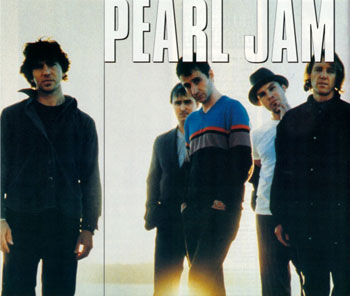
Pearl Jam


Pearl Jam, Formed Seattle, 1990. The genesis of Pearl Jam was rooted in chance and tragedy. Stone Gossard (guitar) and Jeff Ament (bass) had both been members of seminal grungers Green River, and later MOTHER LOVE BONE with ex-Malfunkshun member, Andrew Wood, on vocals. When Wood died of an overdose, his longtime friend Chris Cornell (of Soundgarden) put together a tribute project called TEMPLE OF THE DOG (1991) -- Gossard, Ament and new recruit Mike McCready(guitar) were roped in, as was Eddie Vedder (vocals), who had provided some vocals for a demo tape put together by the others. Once TEMPLE OF THE DOG was in the can Dave Krusen (drums) joined the other four. Flirting with different names on the way (Mookie Blaylock and Reenk Roink), they eventually settled on Pearl Jam, after an allegedly hallucinogenic recipe belonging to Vedder’’s grandmother. By spring 1991, Pearl Jam had begun to play live shows in the Seattle area supporting the likes of Alice In Chains. As the word spread about the Seattle scene, the band signed to Epic and their debut TEN (1992) was rushed out. Although it was recorded speedily, it distilled the pain and attitude of the disaffected, but injected it with an electric, classic rock feel. Gossard and McCready’’s playing owed as much to Jimi Hendrix as to any punk band. Vedder’’s lyrics and vocals carried a rare, raw emotion, and the soaringly poetic ““Evenflow””, ““Alive”” and ““Jeremy”” took elements of his own traumatic childhood and transformed them into universal experience. Just as TEN entered the US charts, Krusen left to deal with personal problems and was replaced by Dave Abbruzzese. Fresh recording sessions produced ““State Of Love And Trust”” and ““Breathe””, for the soundtrack of Singles, a teen-romance comedy based on the Seattle music scene, starring Matt Dillon. Three of the band members even managed to make cameo appearances as part of Dillon’’s grunge combo, Citizen Dick. Despite this media exposure, the press were less than kind to Pearl Jam, reviews equating their driven sound with the rock dinosaurs of the 70s, while Kurt Cobain fuelled the controversy by calling them a corporate band (conveniently forgetting their lengthy apprenticeships for some of Seattle’’s finest). The fans on the other hand could not have cared less; TEN outstripped NEVERMIND in the US metal charts and outsold it worldwide in 1992. A new album was planned for late 1992, but touring schedules slowed things to a crawl. Gossard kept himself fresh by working on SHAME (1993), the sole product of his Brad side-project; it was a mellow, danceable mix of psychedelia and funk rhythms. The summer of 1993 saw Pearl Jam providing support for NEIL YOUNG and tearing into soulful, breathtaking versions of old favourites along with fresh punk-inspired material. They joined Young for a powerful version of ““Rockin’’ in the Free World””, a song they reprised later in the year at the MTV Awards. A new and important alliance had been forged.When VS. (1993) finally saw the light of day, the fan response was awesome, and it entered at #1 in the Billboard charts. The guitars and rhythms raged more freely, and Vedder displayed his vocal and lyrical diversity, with songs of raw, blood-curdling anger (““Go””, ““Animal””, ““Blood””) balanced by mellower textures (““Daughter””). Overall, it sounded more caustic, accomplished and mature than TEN. Pearl Jam have always gone out of their way to be as accessible as possible; if fans write they will usually get a personal reply. This dedication to the public took a new turn in 1994. While continuing to tour, and make occasional appearances with Neil Young, they weighed in against the corporate might of the Ticketmaster booking agency, which they accused of raising prices beyond the spending power of their younger followers. They were joined in their protest by such artists as R.E.M., Aerosmith and, of course, Neil Young, and were to stay in dispute with the agency for the next two years.To show their faith in vinyl, VITALOGY (1994) was first released on record, and then on CD, which saw it rocket to the top of the Billboard charts. Tracks like the searing ““Spin The Black Circle”” and the belligerent threats of ““Not For You”” delivered the usual doses of mayhem. However, tracks such as the pointless ““Stupid Mop”” dragged on the album’’s momentum. Apart from McCready’’s Mad Season side-project, 1995 saw Pearl Jam’’s partnership with Neil Young flourish, their encore jams developing into the poignant, broad sweep of the MIRROR BALL (1995) album. Recorded in a mere four days, the record was a potent blend of Pearl Jam’’s hard rock influences and Young’’s poetic meanderings, oiled with doses of teeth-grating, overdriven feedback. Unfortunately, in a fit of marketing pique, Young’’s record company refused to allow Pearl Jam’’s name to appear on the cover.Meanwhile the band, true to their word, continued to make a stand against Ticketmaster by touring less established venues. Progress was hampered by forced cancellations and security problems, but when things went well audiences were treated not only to Pearl Jam, but to Young joining in on songs from MIRROR BALL. The following year saw the band lose Dave Abbruzzese and finally focus their collective attention on a new studio effort. NO CODE (1996) was steeped in the all-American tradition of garage punk but instead of lunging headfirst into a soundscape of heaving guitars the songs marked out a more thoughtful approach. Opening track ““Sometimes”” was a slow burner and it wasn’’t until ““Hail Hail”” that things kicked off in familiar style. What the album lacked in pace it made up for in poise and moving, troubled lyrics. Overall, though, it received a less-than-ecstatic reception and the band turned back to what they knew best for YIELD (1998) and the live opus LIVE ON TWO LEGS (1998), straight-ahead hard rocking. While LIVE ON TWO LEGS featured former Soundgarden drummer Matt Cameron (replacing Jack Irons) as part of the live set-up, he actually contributed to the writing of new LP BINAURAL (2000). As ever it was a tour de force showcase of the band’’s subtlety and power, addressing both social and personal issues with a deft touch. Later that same year, as if to emphasize the band’’s punk credentials, they also opted to release a series of 25 official live bootleg CDs, all of them recorded warts ‘‘n’’ all during their European tour. The tradition of releasing such bootlegs has continued through each tour in the past few years, and Pearl Jam now hold the World Record for most songs in the Billboard Chart at once, thanks to bootlegs. In 2000, a tragic safety failure at Roskilde claimed the lives of 9 fans and Pearl Jam took this as their responsibilty which it wasn't. The Danish authorities didn't help either, by claiming the band were to blame, although these claims were quickly dumbed down. The Roskilde incident left a huge mark on Pearl Jam's attitude and music, and the band released a statement implying they would probably never play a festival again In 2002 the band released "Riot Act", which contained a mix of acoustic and hard-hitting rock songs with titles such as "Ghost" and "Thumbing My Way". The album title is rumoured to either be named after the "Riot Act" or the "Patriot Act", or maybe a play on both by Vedder. The album's first single "Love Boat Captain" contained the lyric "Lost 9 friends we'll never know", a tribute to those lost at Roskilde in 2000. PJ split from Sony Records after 10+ years under contract, and so Sony cashed in by releasing a 2 Disc greatest hits titled "Rearviewmirror". After many dubbed PJs split from the money grabbing record company, they signed a contract with J Records, an affiliate of Sony, showing that it's difficult to be a big band without the support of a big company these days. However, their music is now more independent and free from constraint, and the band have total control over their music and speed of how they do things. Pearl Jam took part in the Vote For Change Tour in 2004, aimed at raising John Kerry's vote in the US Elections (PJ are strongly against George W Bush)and played at many undecided states such as Boston. Eddie Vedder was quoted as saying that Pearl Jam would move to Canada if Bush won, and he did, but they remain in the US. Pearl Jam did a South American tour in late 2005, amid rumours that the new album would be released in early 2006. Sure enough, in February '06 Pearl Jam announced the new album "Pearl Jam" would hit stores on May 2nd. The first single was accepted as a "grower" and the band were quick to sell out tickets to a North American tour and book festivals across the world, breaking their no-festival stance to the joy of festival goers and organisers. It is rumoured that Pearl Jam's self titled album is a sign of their acknowledgment that the end is near. Perhaps family commitments and such will slow the band down, maybe stop it all together, but I personally feel that Pearl Jam crave their career as passionate music makers too much to stay away from the music, and we can expect their already lengthy careers to become more fruitful and evolved over the next few years!

Thursday, December 27, 2007

Led Zeppelin


"How can you consider flower power outdated? The essence of my lyrics is the desire for peace and harmony. That's all anyone has ever wanted. How could it become outdated?"- Robert Plant, lead singer, Led Zeppelin

On 10th of December legendary rock band Led Zeppelin performed their old magic in O2 Arena in London. Like a vintage wine they enthralled and mesmerized 20 thousand people with same vigor they had some 20 years ago when they had their last stage show in 1980. Led Zeppelin is one of that rare kind of rock band who still reckon with their incomparable voice and music. Defying age and time they decided to come back where they were belong to, the stage where under the illusion of light they made every rock & roll mad twist and twirl with the amazing voice of Robert Plant and eternal guitar riffs of Jimmy Page and John Paul Jones. With almost, the same power and energetic tempos of all the old songs, Led Zeppelin made another history which they have been a part of itself. The legacy of the golden age of rock & roll still goes on and gracing the whole rock & roll aficionado all over the world. They performed Stairway to Heaven, Whole Lotta Love, Since I've been Loving You, Kashmir, Good Times Bad Times, Misty Mountain Hop and many more from their legendary bouquet of songs with their iconic thunderous energy and urge to set fire on the stage and the fans.

Like Led Zeppelin, across the globe those old veteran rock & roll legends and bands that started translating their musical passion into musical phenomenon still gigging defying old age, odd and bad times. One of the legendary rock band of all time Scorpions now out for a world tour with their Humanity Hour began their journey long way back to 1965 when the then teenage German boy Rudolf Schenker tried to catch his dreams of playing guitar and singing. It became Scorpions 1969 when his younger brother Michael Schenker and a singer who later became a legendary vocalist of all time by the name Klaus Meine. From their first album Lonesome Crow in 1972 to their latest Humanity Hour I, it's really a long journey but for the decades they have been making their fans spellbound with their music. During their album Animal Magnetism Klaus Meine suffered a throat problem and he had to undergo surgery in his voice box. There was doubt whether Meine would able to sing again. But with all effort and god's grace Meine recovered and bounded back to the stage not only for the moment but till today he is crooning the whole rock & roll fan hood with his phenomenal voice. Despite many ins and outs of members Scorpions is still regarded as one of the finest rock band the world ever have. Though at present they are on world tour with comparatively two new members bassist Pawel Macioda and drummer James Kottak the old trio of Rudolf, Meine and Matthias Jabs have become legends of the Rock & Roll Hall of Fame.

Outside America and Britain one who became history with all their prodigious talent is the Irish band U2.Formed in 1976 in Dublin this band over the years has established themselves as one of the most loved and successful band of all time. From their first studio album Boy in 1980 to the last How to Dismantle an Atomic Bomb in 2004 U2's journey is one to be remembered with love. With 22 Grammy Awards they have surpassed any other bands in the history of rock & roll. Apart from their musical superlative they have become famous and earned much accolades for their concern over the eradication of poverty, disease and social injustice.

Another rock band which made us mad by their amazing stuff is none other than the Eagles, the American band who started their journey on the long road out of Eden in 1971! On 1 st of April Linda Ronstadt recruited Glen Frey, Don Hanley, Bernie Leadon and Randy Meisner for her touring band and they toured with Linda for two months. Later encouraged by Linda they decided to start their own and signed with Asylum Records, a new label started by a person who himself later became part of rock & roll history as David Geffen. Their first single Take It Easy reached 12 th position in the US billboard followed by Witchy Woman at 9th. With so many famous songs like legendary Hotel California, Life in the Fast Lane, Tequila Sunrise,I Can't Tell You Why, James Dean, Heartache Tonight, Best of my Life, One of these Night, New Kid in Town the Eagles became one of the most outstanding rock band of all time. Like other famous bands Eagles also could not escape breaking of band. In 1980 all they had were over. One of the founders Glenn Frey later wrote to Don Henley that he started the band, he got tired of that and he decided to quit. But music did not let them to go into oblivion. After almost a decade they reunited again in 1994 and performed live at Warner Burbank Studio. They presented their fans one more fabulous album titled The Eagles: Hell Freezes Over. And in 1998 this legendary band was inducted into the Rock & Roll Hall of Fame.They still did not stop and this year they have released their first studio album since 1979 titled Long Road Out of Eden. Its title song How Long has already reached top one position in U.S. Billboard Bubbling Under Hot 100 chart.

Apart from these bands those who graced the history of rock & roll with their charismatic talent and mastery some of the individuals also still gigging in the scenario of world of music. Eric Clapton, Elton John, Carlos Santana, Paul McCartney, Phil Collins, former Pink Floydian Roger Water and David Gilmour to name a few. In the words of Scorpions they are still rocking like a hurricane. Still we take the stairway to heaven and get the solace with these legends' amazing music and their eternal musical demeanor. Like the old wine with time they become more and more tastier and pleasant ever before.

Guns N Roses


It all begun in Los Angeles in 1985 when William Bailey (Axl Rose - vocals) formed a rock band with Jeffrey Isbell (Izzy Stradlin - guitar), Tracii Guns (guitar) and Rob Gardner (drums) called in turn Rose, Hollywood Rose and L.A Guns. Soon Guns and Gardner were replaced by Saul Hudson (Slash - guitar) and Steven Adler (drums) and with the addition of bass player Duff McKagan the band was renamed to Guns N' Roses. Playing a unique sound incorporating punk, blues and metal, the band released a self-produced live album called "Live ?!*@ Like A Suicide" in 1986. Having received some interest from the music industry the band signed to Geffen Records.


The following year the band released their debut album "Appetite For Destruction" which, despite being the best selling debut album of all time, it only started selling a year latter when MTV started playing "Sweet Child O' Mine"! The album shoot to number 1 and Guns N' Roses became overnight one the biggest bands in the world. During their performance at the legendary 1988 Monsters Of Rock Festival in Donnington that also featured the likes of Iron Maiden and Kiss two fans died during crowd disturbances.
At the end of 1988 the band released "Lies" which featured four new acoustic songs and tracks from "Live ?!*@ Like A Suicide". The album hit number 2 of the charts but controversially the song "One In A Million" sparked intense controversy for its violent and racist lyrics. Also when in 1989 Guns N' Roses were awarded at the annual award show for best heavy metal album and best heavy metal song for "Appetite For Destruction" and "Paradise City", McKagan and Slash used strong language on live television.

Shortly after the release of "Lies" drummer Steve Adler was fired and replaced by Matt Sorum from the Cult and during the recording of their long-awaited second studio album the band added keyboardist Dizzy Reed. Under the new lineup Guns N' Roses released "Use Your Illusion I" and "Use Your Illusion II" which simultaneously shoot at the two top spots of the charts.
The band then went on a colossal 28-month long world tour which was hugely successful but also very eventful. The most famous incident took place in the summer of 1991 when during a show in Missouri Rose jumped into the crowd injuring a fan and then left the stage. The angry crowd begun a riot in which many people were injured. During this period Stradlin quit the band due to differences with Rose and was replaced by Gilby Clarke.

In 1993 the new lineup released a collection of punk covers named "The Spaghetti Incident?" which received some good reviews, however, it did not match the brilliance of their previous three studio albums. In conjunction with a number of other events, including the release of the "Nevermind" album that shifted musical interest to Nirvana and internal disputes between Rose and the rest of the band, Guns N' Roses gradually declined. By 1997 the band disintegrated leaving Rose the sole original member of the band. In the years that followed Guns N' Roses remained relatively unnoticed, occasionally making the headlines for the wrong reasons including riots in their gigs, cancelled shows and the long delayed fifth studio album "Chinese Democracy". The only releases from the band since 1993 were the two compilation albums "Live Era '87-'93" (1999) and "Greatest Hits" (2004). A notable attempt from previous Guns N' Roses members came in 2003 when Slash, Duff McKagan and Matt Sorum formed the band Velvet Revolver with Scott Weiland formerly with the Stone Temple Pilots. Their debut album "Contraband" released in June 2004 received good reviews and went straight to the top of US charts.

When it comes to living dangerously, few bands can claim they have done more so than Guns N' Roses.No other band managed to cement such an untouchable legendary status with just four studio albums. The absolute encapsulation of "Sex, Drugs And Rock N' Roll" was to rise and fall in less than a decade.

Wednesday, December 26, 2007

The Rolling Stones


FORMED: January 1963, London, England The Rolling Stones define rock 'n' roll. They are the longest running act in the history of rock music, having remained wildly popular and prodigiously productive over their 30-year career. The group was formed by Mick Jagger and Keith Richards, who met as schoolmates in Dartford, Kent. The legend has them bumping into each other on the platform at Dartford railway station, where Keith notices a blues album under Mick's arm. A bond is struck immediately and the pair go on to form a band with a variety of personnel, who eventually include a boogie-woogie pianist called Ian Stewart and a gifted blonde blues guitarist from Cheltenham called Brian Jones (although at the time he is calling himself Elmo Lewis for added authenticity). The best way to chronicle the Rolling Stones' accomplishments is to break it down by year: 1962 The Stones are just three of a growing circle of musicians who were devoted to the music of American artists like Chuck Berry, Howlin' Wolf, Muddy Waters and Elmore James. They perform these artists' songs with an almost missionary zeal to further the R&B cause, as well as earn enough money to stay alive. For some months, the impoverished early Stones live in squalor in London's Edith Grove. They beg gigs from older, jazz-tinged luminaries like Chris Barber, Cyril Davies and Alexis Korner, yet such is the Stones' raw energy and rapid development, they soon leave behind the somewhat purist and divided world of the jazz and blues establishment. In July, the Stones take their name from a Muddy Waters song called "Rollin' Stone Blues" and make their live debut at London's Marquee Club (minus Bill Wyman and Charlie Watts). They start playing pubs and clubs around the city and suburbs. Bill Wyman joins late in the year -- the popular story being that he was asked because he had his own amplifier! 1963 In January, Charlie Watts joins the Stones and plays his first gigs. The band gigs constantly with residencies at venues like Ealing Jazz Club, Ken Colyer's Studio 51 and Eel Pie Island in Twickenham. Audiences often consist of fellow budding blues musicians like Jimmy Page, Eric Clapton and Pete Townshend. Their weekly steamy nights at the Crawdaddy at Richmond's Station Hotel result in ecstatic press reviews, and in April a sharp young mover called Andrew Loog Oldham catches the Stones at the Crawdaddy and signs them to his management company the next day. He starts the "Would you let your daughter marry a Rolling Stone" press campaign which endears the group to hordes of youngsters who find the Beatles a tad cute. The shockwaves are still being felt today. In May, the Stones are signed to Decca Records by an A&R man infamous for turning down the Beatles. A month later "Come On," the first Rolling Stones single, is released. An older generation recoils in horror as the group performs the song on England's top pop TV show "Thank Your Lucky Stars." The song -- an obscure Chuck Berry cover -- climbs to No. 21 on the U.K. charts. The second single, "I Wanna Be Your Man," is given to the group by John Lennon and Paul McCartney after they run into the Stones on the street. They finish writing it on the spot. That reaches No. 12. Live gigs are already attracting hordes of screaming teenage girls who drown out the band. 1964 The group start the year on their first major package tour supporting America's Ronettes, the girl group produced by Phil Spector. In January, the Rolling Stones EP -- four covers of current U.S. rock'n'soul classics -- appears. In February, they release a third single, a version of Bo Diddley's "Not Fade Away," which features Phil Spector on maracas. By now the Stones are becoming a ferocious R&B machine. They ditch the stage uniforms, grow their hair longer and inspire a legion of lookalikes. No group in history has sparked such horror in the older generation. "Not Fade Away" becomes the Stones' first Top 10 entry, hitting No. 3. The first album immediately sparks controversy for being untitled and featuring no writing on the cover. It reaches No.1. The record mainly consists of raw, feisty covers by heroes like Chuck Berry and Willie Dixon. It also features the first bona fide Jagger/Richards composition, "Tell Me," which was written after Andrew Oldham locked them in his kitchen with the intent of writing some songs. In April, there's teen mayhem when they play the NME Pollwinners' Concert at Wembley Arena. In June, the band's cover of the Valentinos' "It's All Over Now" becomes the Stones' first No.1 and gold record. It was recorded at Chicago's legendary Chess studios -- home of Muddy Waters and other Stones heroes -- during the group's first visit to the States that month. The Stones go on to predate the dance music explosion by 25 years and headline their fan club's "All Night Rave" at London's Alexandra Palace, which also features John Lee Hooker and winds down at 6:30 a.m. In August, more Chess material appears on the Five By Five EP, and November caps an eventful year with another chart-topper -- a cover of Willie Dixon's "Little Red Rooster." 1965 The momentum continues -- as does the band's superhuman schedule -- with a second chart-topping album, Rolling Stones Number 2. In February, the single "The Last Time" (the first A-side to be written by Mick and Keith) also hits No. 1. In August "(I Can't Get No) Satisfaction" sweeps the world and becomes one of the biggest Stones anthems ever. Keith says he woke up in the middle of the night in a motel room with that riff in his head and had to whack it down there and then. The following month sees the release of the Got Live If You Want It EP -- a noisy record of the live show recorded over the first three days of the March U.K. tour. The Out Of Our Heads album, recorded between U.S. dates and featuring a bunch of Jagger/Richards gems, is released in July. The chart topping "Get Off My Cloud" puts the cap on another action-packed year. 1966 February sees the single "19th Nervous Breakdown," followed by the ground-breaking, chart-vaulting Aftermath album, on which the Stones start to experiment with different instruments and 11-minute tracks. Every song is written by Mick and Keith. In May, the expansion of the Stones' sound continues on the number one "Paint It Black" single, where Brian's sitar rides the pummelling beat. September's "Have You Seen Your Mother Baby, Standing In The Shadows?" single sees the group's first dabblings with full-on psychedelia. October sees the group's last U.K. tour for three years (with Ike & Tina Turner supporting). 1967 The Between The Buttons album sees a further flowering of the psychedelically inclined studio experimentation expanding the Stones' current whimsical English pop music. In February, Mick and Keith are arrested when Keith's Redlands home is raided by the police. Thus starts the run of high-profile court appearances that divide the nation's generations and are widely believed to be part of some greater conspiracy to silence the unbelievably powerful Stones. But despite all the charges hurled against Jagger, Richards and Jones, no Stone went to jail for any extended period. After the bust, the Stones tour Europe to literally riotous responses in many cases, and headline the massively popular "Sunday Night At The London Palladium" TV show, where they perform the already-controversial "Let's Spend The Night Together" single and its genteel flip "Ruby Tuesday." They spark further outrage by refusing to ride on the silly roundabout at the end of the show. In August, the hastily assembled "We Love You" single is released to thank the public for their support during the Jagger/Richards trials. Lennon and McCartney pop up on backing vocals while Mick and girlfriend Marianne Faithful return the favor by joining in with the Beatles "All You Need Is Love" for the "Our World" simultaneous satellite TV broadcast. In December, the highly experimental Their Satanic Majesties Request album baffles many with its extended psychedelic explorations, but still hits the top three. Much attention is focused on its three-dimensional sleeve. 1968 In May, the Stones make a surprise appearance at the end of the NME Pollwinners' Concert. It is immediately obvious that the group have returned to their blues roots as they tear into the new "Jumpin' Jack Flash" single and "Satisfaction." After the uncertainty of the previous year the Stones are back to claim their crown as Greatest Rock 'n' Roll Band In The World. "Jumpin' Jack Flash" is released later that month and pole vaults to the top. The Beggars Banquet album is supposed to follow in August, but Decca objects to the Stones' graffiti-splattered toilet wall sleeve and it finally emerges in a plain white cover in December. The album launch party ends up with the Stones hurling custard pies in the faces of Decca executives. The album itself shows a new maturity and bluesy raunch, as well as the dark and dangerous image epitomized by "Sympathy For The Devil." 1969 After a meeting with other band members, Brian leaves the Stones on June 8, saying he wants to form a new group. A few days later the Stones hold a photo call in London's Hyde Park to introduce their new guitarist, Mick Taylor, who was formerly in John Mayall's Bluesbreakers. He will make his live debut with the Stones at a free concert to be held in the park on July 5, and plays on the upcoming single, "Honky Tonk Women"/"You Can't Always Get What You Want." On July 3, Brian Jones is found dead in his swimming pool in Sussex. The Hyde Park gig becomes a memorial for Brian and the group unveil their new songs. The classic bar room raunch of "Honky Tonk Women" is unleashed a week later and shoots to No. 1. The chart-topping Let It Bleed album is released in December and turns out to be another feast of apocalyptic blues ("Gimme Shelter"), salacious melodrama ("Midnight Rambler") and more tales from the darkside. The Stones embark on their first U.S. tour since 1966 and, in the new climate of audiences who sit and listen, find the new live power and sense of occasion which remains with them to this day. The U.S. tour climaxes in December with the tragic Altamont Speedway concert. 1970 Two years after it was filmed, Mick Jagger's movie debut in Nic Roeg and Donald Cammell's Performance finally gets released. Jagger plays reclusive rock star Turner. It's accompanied by a soundtrack to which Mick contributed "Memo from Turner." In September, a live album of the previous year's Madison Square Garden show New York, Get Yer Ya-Yas Out, hits No. 1. It's initially designed as an official alternative to the Stones bootlegs starting to appear. The 1969 tour also results in the movie, Gimme Shelter. 1971 The Stones, whose contract with Decca has expired, launch their Rolling Stones Records imprint with the mighty double header of "Brown Sugar" and "Bitch," which continue to push the barriers and court controversy with their lyrics. The band undertake a farewell tour of the U.K. as they prepare to go into tax exile in the south of France. In April the mothership album, Sticky Fingers, appears with a sleeve designed by Andy Warhol, which depicts a mystery groin complete with adjustable zipper! While the rock 'n' roll is sleazier than ever, a beautifully damaged haze hangs over tracks like "Sister Morphine" and "Wild Horses," which features the country influence of Keith's new mate, Gram Parsons from the Flying Burrito Brothers. 1972 In April, the Top Five hit "Tumbling Dice" is the first single to trailer the upcoming double album Exile On Mainstreet, recorded in the basement of Keith's house in the south of France. The album is derided at the time for sprawling self-indulgence, but Keith is always glad to point out that it is now held up among the band's most enduring work. The Stones tour the States -- described by organizer Pete Rudge as "not like a rock 'n' roll tour, more like the Normandy landing." It sees the group setting a standard of the grand spectacle required for stadium gigs. 1973 In August, the balladic "Angie" trailers the more melodic Goats Head Soup album, recorded in Jamaica; stirring it up with the controversial "Starfucker" finale. The tour hits Europe, including a spectacular stretch at Wembley Arena. 1974 July's Top 10 single, "It's Only Rock'n'Roll," started life in Ronnie Wood's South London home studio, with David Bowie on backing vocals and the Faces' Kenny Jones on drums. The roughhouse rock feel is continued on the album of the same name, although the highlight could be considered the haunting ballad, "Time Waits For No One." The Stones/Wood connection becomes closer when Keith appears on most of Ronnie's first solo album, I've Got My Own Album To Do, and both Mick Taylor and Jagger guest. Keith appears with Ronnie at his Kilburn State gig in July. In December Mick Taylor quits to pursue a solo career. 1975 After much speculation and a string of recording sessions-cum-auditions in Munich, which eventually give birth to the Black and Blue album, the Stones announce Mick Taylor's replacement -- Ronnie Wood. (Candidates who didn't get past the jamming phase include Jeff Beck, Peter Frampton and Rory Gallagher). Ronnie has already taken leave from the Faces to tour with the Stones, and Keith admits he nearly asked him to join back when Brian left. 1976 Black and Blue is released in April and features those guest spots from guitarists Harvey Mandel, Wayne Perkins and the successful Mr. Wood. "Fool to Cry" is the single and makes the Top 10. That summer, the group tour and appear straddling an unfolding lotus stage complete with giant inflatable penis and Tarzan rope for Mick. 1977 In February, Keith and Anita Pallenberg are busted in Toronto, where the Stones are playing some low-key club dates to record for an upcoming live album. October's Love You Live double album features songs from the previous tour and a side from the Toronto gigs at the El Mocambo club. 1978 The dance music-influenced "Miss You" (one of the early 12" singles) hits the number one spot in the U.S. The Some Girls LP follows. Originally called Some More Fast Numbers, some say the charged energy level is influenced by the recent punk rock explosion. In fact, the next single, "Respectable," shows the group commenting on their new status as "pillars of society" -- before slamming into brief acquaintance Margaret Trudeau, the Stones-slumming wife of the Canadian Prime Minister. The Stones tour America to wildly enthusiastic audiences and equally ecstatic reviews. All stage props have been stripped back, to allow room for the new energy coursing through the group with a totally integrated Ronnie Wood and fully-cylindered Keith Richards. 1979 Wood releases a third solo album, Gimme Some Neck, which again features Keith and Mick. In April, the Stones join together to support Keith, doing a set for the Benefit Concert for the blind which honors the Toronto court's sentencing commitment. Keith then joins Ronnie for the New Barbarians tour. The Barbs appear at the Knebworth Festival supporting Led Zeppelin. 1980 In June a new single, the reggae and disco-tinged "Emotional Rescue," trailers the album of the same name and hits the Top 10. 1981 August sees "Start Me Up" motor into the Top 10 as a slashing kickstart trailer for the upcoming album, Tattoo You, which also includes the warm follow-up single, "Waiting On A Friend." The Stones undertake the first of periodic mega-tours which sees them astride a colossal stadium-stage, complete with hydraulic platforms and huge avant garde paintings. 1982 The Stones tour hits Europe, including several nights at London's Wembley Stadium. In June, the Stones release Still Life, a live album drawn from the '81 American gigs along with the group's cover of "Going To A Go Go." 1983 It's August and in typical Stones fashion, an agreement is reached and signed at 3:00 a.m. in Paris' Ritz Hotel by Mick Jagger, Keith Richards and CBS head Walter Yetnikoff. The deal is reportedly worth 28 million dollars and calls for the Stones to deliver four studio albums. In October, the "Undercover Of The Night" single is unveiled with the theme of South American political unrest dominating an epic video directed by Julian Temple. Mick's execution scene stirs some controversy while Keith sports a skull mask and a gun. The single reached the Top 10, as did the album with its peel-the-stickers-off-the-stripper sleeve. 1985 In February, the Stones are in Paris recording Dirty Work at Pathe-Marconi Studio. Mick Jagger releases his first solo album, She's The Boss. In June he duets with David Bowie on the specially recorded version of "Dancing In The Street" for Live Aid. Mick also appears at the all-day event in Philadelphia, singing a saucy duet with Tina Turner in which he whips off her skirt. It's his first ever live solo set performed in front of 1.5 billion viewers. Later that day, Keith and Ronnie flank Bob Dylan for an acoustic set to close the show at JFK Stadium. Three months later, Keith and Ronnie repeat their acoustic act, backing Bono for a version of "Silver And Gold," which appears on the Artists United Against Apartheid album. Later that year, the Stones begin work on a new album. Near the end of the sessions -- which the group later admit were not their most harmonious -- their road manager, soul brother and "Sixth Stone" Ian Stewart dies of a massive heart attack in London at the age of 47. Ian had been with the group since the start and still played piano on stage. "We all felt the glue had come unstuck," says a grieving Keith. 1986 "Harlem Shuffle" -- a cover of Bob & Earl's 1964 hit featuring soul legend Bobby Womack on backing vocals -- is released in March and hits the Top 20. The Dirty Work album follows and is dedicated to Ian Stewart. It closes with one of Keith's most moving ballads, "Sleep Tonight." Again there is no tour although Charlie takes the big band across the States later that year and repeats the exercise during lulls in the Stones' schedule from then on. 1987 Keith records his first solo album for Virgin Records at Montreal's Le Studio. Taylor Hackford's Chuck Berry tribute, Hail! Hail! Rock'N'Roll, opens in October. Keith is the musical director of the movie, which features performances by Chuck Berry, Eric Clapton, Etta James, Julian Lennon, Robert Cray and Richards himself. 1988 Mick releases his second solo album, Primitive Cool, and enjoys an hugely successful tour of Japan and Australia. In September, Keith's debut album, Talk Is Cheap, is released. He follows this with a three-week sold-out tour of the U.S. with his back-up band, the X-Pensive Winos. "Take It So Hard" is the first single and video released. On October 16th, Keith, whose house in Jamaica suffered hurricane damage, guests at the "Smile Jamaica" hurricane relief benefit concert at the Dominion Theater, London. He plays two songs with U2-- "Love Rescue Me" and "When Love Comes To Town." 1989 At the start of the year, the Rolling Stones are inducted into the Rock and Roll Hall Of Fame. Mick, Keith, Ron and Mick Taylor are present at the ceremony held at the Waldorf-Astoria in New York. The absence of Wyman and presence of Taylor sparks rumors that the Stones will tour with Taylor replacing Wyman, and Ron Wood will move to the bass. Pete Townshend helps induct the Stones, telling them in his speech, "Guys, whatever you do, don't try to grow old gracefully. It wouldn't suit you." Mick replies in his own speech: "After a lifetime of bad behavior, it's slightly ironic that tonight you see us on our best behavior." Mick, Keith, Ronnie, and Mick Taylor join the now-expected all-star jam session, during which Mick duets with Tina Turner on "Honky Tonk Women," and with Little Richard on "Can't Turn You Loose" and "Bony Moronie." He then brings down the house with "Start Me Up." Keith releases his second video "Make No Mistake," directed by Paula Grief, from Talk Is Cheap in March. In May, he is presented with the "Living Legend Award" at the International Rock Awards. Earlier, Mick and Keith meet at Eddy Grant's studio in Barbados to see if they can still write songs together. Before the meeting, there's speculation as to whether the two can still remain in the same room. Two months later, they have 12 new tunes ready, plus the usual welter of unfinished ideas. Working like they did on the classic albums of the '60's and '70's -- from the groundfloor and building -- they come out with a string of gems, which are then honed and bashed into shape by the whole group at George Martin's AIR Studios in Montserrat with Chris Kimsey co-producing. The band whack everything down live in five weeks, with mixing to follow in London. In July, the Rolling Stones hold a press conference at New York's Grand Central Station to announce their forthcoming Steel Wheels tour and album. Mick holds up a ghetto blaster and plays the new "Mixed Emotions" single to the assembled world media. It's released in August and puts the group back onto the world's charts. Steel Wheels is a Stones classic. A complete album of new stuff, as opposed to touched up old demos like much of the late-'70's and '80's output. The sound is raw and bristling on tracks like the first single, "Mixed Emotions," but the album also proves the band can still deliver gorgeous ballads like "Almost Hear You Sigh," or Keith's lovely "Slippin' Away." While the album is generally acclaimed as the group's best in years, the group make it a double whammy with the awesome scope and spectacle of the "Steel Wheels" tour. The stage set is the biggest ever, a surreal post-nuclear nightmare factory, all girders, funnels and catwalks bathed in ferocious lighting and walls of fire and smoke. The set straddles the Stones' entire career in over two hours with every song a piece-de-resistance -- from the giant inflatable "Honky Tonk Women" to Mick's materialization one hundred feet above the stage for "Sympathy." The group play like their lives depend on it, and also like they were having a total blast. Starting in Philadelphia on August 30, the huge operation (a veritable mobile army) goes on to play around 70 gigs. In December, the U.S. leg ends up at the Atlantic City Convention Center for a radio-TV simulcast. Guests include John Lee Hooker, Axl Rose and Izzy Stradlin from Guns 'N Roses, and Eric Clapton. 1990 In February, the Stones tour Japan for the first time with 10 sold-out shows at Tokyo's Korakuen Dome, playing to 50,000 a night. For Europe, Steel Wheels gives way to Urban Jungle -- partly because European stadiums aren't big enough for the huge set, partly because they just fancied a change of scenery. The new stage resembles a post-nuclear tropical ruin, with giant inflatable dogs appearing during "Street Fighting Man." It hits London's Wembley Stadium in July, then again in August at the end of the tour, with the resurrection of the Steel Wheels set. Over the past year, the Stones have played 115 shows to over six million people. 1991 All five members of the band immerse themselves in solo projects. In November, at the London office of the Stones' financial advisor Rupert Loewenstein, Mick, Keith, Charlie, Ronnie are present for the signing of the Stones' deal with Virgin Records. 1992 The Stones take the year off to recharge their batteries. Meanwhile Richards records and releases his second solo album, Main Offender, on Virgin. He tours Europe and then goes where no Stone has gone before -- Argentina, where the X-Pensive Winos play to a Buenos Aires crowd of 40,000. 1993 The Stones celebrate the 30th anniversary of the release of their first single. During a live interview on the BBC's "London Tonight" news program in January, Bill Wyman finally makes it official: "I really don't want to do it anymore." Regarding his efforts to prevent Bill from quitting, Keith states: "I did everything but hold him at gunpoint." Also in January, Ronnie plays the first of four solo concerts in Japan, wrapping up on the 14th at Tokyo's Budokan. Meanwhile, Mick releases his third solo album, Wandering Spirit. The night of the release, Mick plays a private concert for 1,200 invited guests at New York's Webster Hall. Guests include Robert De Niro and Francis Ford Coppola. Mick performs 11 songs from his new album, then encores with the Stones' "Rip This Joint," "Live With Me," and "Have You Seen Your Mother, Baby (Standing In The Shadows)?" The tour ends with sell-out shows in Tokyo. Three days later in Seattle, Keith opens the U.S. leg of his Main Offender tour. Later in the year, Billy Joel ind ucts Keith into the Songwriters' Hall of Fame. 1994 After pre-production in Barbados, the Stones gather in Dublin, Ireland at Windmill Studios to start work on a new album. Their first under a new deal with Virgin, the band sees much of the back catalogue re-mastered on CD. Don Was is picked as co-producer of Voodoo Lounge alongside the Glimmer Twins. Was, who made his name with the surreal rock 'n' soul of Was Not Was, has recently produced Bonnie Raitt, the B-52's, Bob Dylan and Iggy Pop. Bassist Darryl Jones and keyboard player Chuck Leavell are called in to help out. Other guests include Ivan Neville, Bobby Womack, Bernard Fowler, Benmont Tench, Flaco Jimenez and Luis Jardim. The results are staggering. As virtually all reviews have pointed out, Voodoo Lounge is peak Stones; a group firing on all cylinders. After the success of the Steel Wheels project, the Stones know they have nothing to prove and the new sound seems less self-conscious and more inventive than their recent work. It's the sound of a group getting together and raising the hell they know and love. Mick's singing is stronger and more expressive than usual, notably on the chilling anti-terrorism ballad "Blinded By Rainbows," and lascivious car song "Brand New Car," which is in the best tradition of double entendre blues. Like all Rolling Stones classic albums, each song is propelled by Keith's explosive guitar riffs and underpinned by Charlie's ferocious drumming. The album and its accompanying tour is announced in New York -- this time after the group arrive via boat at Pier 60. The tour kicks off on August 1 at Washington. D.C.'s RFK Stadium, and plays the U.S., Canada, Japan, Mexico, South America and the Far East. As Bobby Keys, long time Stones sax player, once remarked in a choice moment during the 1971 outing: "Looks like rock 'n' roll is on the road again!" And how! The Voodoo Lounge tour launches with a shower of praise from critics and fans alike. In between playing to sold-out shows in stadiums across the U.S., the Stones find time to pick up an MTV Lifetime Achievement Award, plus a Billboard Award for Artistic Excellence. The band also make history on November 10, when they become the first rock 'n' roll band to broadcast a concert live on the Internet. By the end of the year, sales of the Voodoo Lounge album pass the four million mark, and the North American leg of the tour is written into the record books as the most successful tour in history. 1995 The year starts in Stones' usual breathless fashion -- this time because of the high altitude of Mexico City's Autodromo Stadium. A lack of oxygen was no problem throughout the South American leg of the tour. Having never played South America as a band before, the Stones are greeted with a fever-pitch hysteria that's overwhelming, even by Latin standards. In Argentina, they are mobbed wherever they go and are kept awake by 5:00 a.m. reprises of the chorus of "Wild Horses." The band sweep through South Africa, a seven-night sell-out stand at the Tokyo Dome, and Australasia before embarking on the final leg of the tour in Europe on June 3 in Stockholm. In Montpellier, they are joined on stage by Bob Dylan for the aptly-titled "Like a Rolling Stone." The band later release their version of the song as a single. While on the road, the band find time to stop and record acoustic versions of classics like "Street Fighting Man," and more arcane numbers like "Spider and the Fly" and "I'm Free." These tracks make up the live acoustic album Stripped. The tour ends in Rotterdam on August 30 with the promise that this will definitely not be the last time. While the release of Stripped is seen as a present-day celebration of past glories, the Stones end the year by re-enforcing their commitment to the future by making it enhanced with multimedia content. The band also launch their second official website (Stonesworld) and release their debut CD-ROM (Voodoo Lounge). 1996 Even when not active, the Stones are everywhere, with music featured in Casino (released late in '95), Basquiat (in which Keith also has a song called "Nearness to You" recorded in 1980), and The Fan. Meanwhile, the band once again get involved in solo projects. Charlie Watts is the first to break cover with the release of his quintet's Long Ago & Far Away, which features classics from the likes of Cole Porter, Duke Ellington, Louis Armstrong and Hoagy Carmichael. At his home in Jamaica, Keith completes production work on an album which features traditional Rastafarian Bingi drums (to be released later this year). 1997 The Stones continue to redefine rock music and themselves in the process. The ageless rockers begin recording the follow-up to Voodoo Lounge in a Los Angeles studio with executive producer Don Was and producer Kenneth "Babyface" Edmonds. The Dust Brothers (Beck, the Beastie Boys) take over behind the mixing board, with mixer/producer Danny Saber (who has re-mixed tracks for U2 and Garbage) and Was also producing a few songs each. Bridges To Babylon is released in the fall. 1998 In November, the Stones chronicle their 1998 tour with the release of No Security, their third live album of the decade.